India’s summers are among the most demanding in the world. In cities across Gujarat, Rajasthan, Maharashtra, and the Gangetic plain, daytime temperatures routinely exceed 40°C from March through June , and the urban heat island effect in densely built cities pushes perceived temperatures higher still. For Indian homeowners, the battle against summer heat is fought on multiple fronts: air conditioning, ventilation, insulation, and increasingly, paint. Heat reflective paint India is not a fringe technology , it is a mainstream, scientifically validated solution that is changing how Indian buildings manage thermal load.
The Science of Heat Reflective Paint
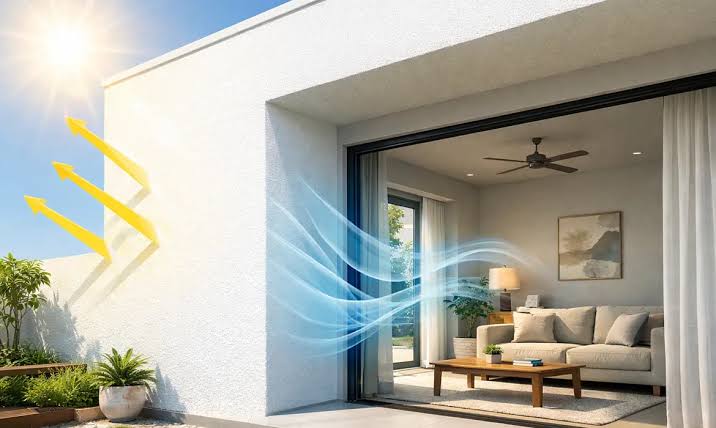
Solar reflective paint India works on a deceptively simple principle: conventional exterior paints absorb solar radiation (particularly in the near-infrared spectrum, which accounts for approximately 53% of total solar energy), converting it to heat that conducts through the wall surface into the building interior. Heat reflective paint India contains specially engineered pigments and particles that reflect a significantly higher proportion of this solar radiation away from the surface rather than absorbing it.
The key metric is Solar Reflectance Index (SRI) , a measure of how well a surface reflects solar energy. Standard dark or medium-coloured exterior paint may have an SRI of 20–40. Premium solar reflective paint India formulations achieve SRI values of 80–100 or higher, meaning they reflect the vast majority of incident solar energy away from the wall or roof surface.
Cool Roof Paint India: Where the Impact Is Greatest
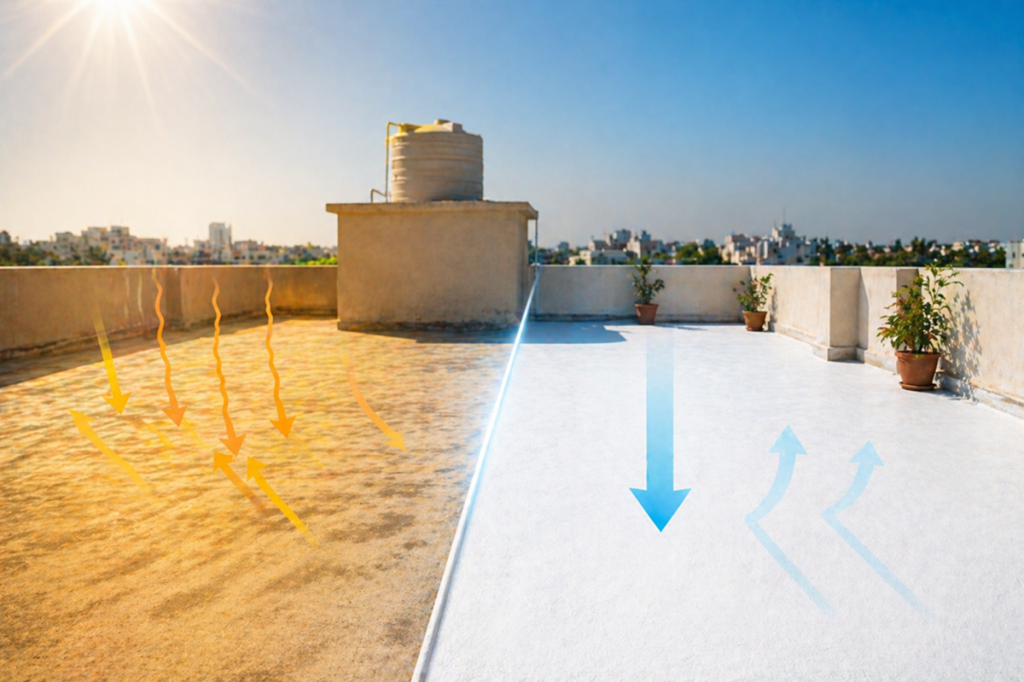
The roof is the primary solar collector in any building. A flat concrete roof painted with a standard exterior emulsion in a medium tone may reach surface temperatures of 70–80°C on a peak summer day in India , and this heat conducts directly into the rooms below. Cool roof paint India applied to the same surface can reduce peak roof surface temperature by 20–35°C, with corresponding reductions in the temperature of the room directly beneath the roof.
The practical implication is significant: temperature reducing paint India on a roof surface can reduce the cooling load on air conditioning systems by 20–40%, translating directly into lower electricity bills. For homes without air conditioning, cool roof paint India can make the difference between a habitable and an uninhabitable top-floor room during peak summer months.
Heat Resistant Paint for Walls: Vertical Surface Benefits
While roofs offer the greatest thermal benefit, heat resistant paint for walls on west and south-facing vertical surfaces also delivers meaningful results. West-facing walls receive intense afternoon sun in Indian summers , the most intense and prolonged solar exposure of the day. Solar reflective paint India on these walls reduces the heat conducted into adjacent rooms during the afternoon hours, when indoor temperatures typically peak.
Heat proof exterior paint India on vertical walls also protects the paint film itself from thermal degradation , a significant factor in the longer paint life that heat reflective products offer compared to standard exterior emulsions.
Thermal Insulation Paint India: Managing Expectations
A word of clarity on thermal insulation paint India is important. True thermal insulation , the kind provided by materials like mineral wool or expanded polystyrene in cavity walls , is a structural intervention that paint cannot replicate. What summer heat paint solution India provides is primarily surface reflectance (reducing heat gain at the surface) rather than bulk insulation (slowing heat transfer through the wall mass). These are different mechanisms, and both matter.
The most effective approach combines solar reflective paint India on exterior surfaces with appropriate bulk insulation in the building envelope , but for existing buildings where structural insulation retrofitting is impractical, reflective exterior coatings offer the most accessible and cost-effective thermal improvement available.
Energy Saving Paint India: The Economic Case
Energy saving paint India makes a compelling financial argument when the full lifecycle is considered:
- Reduced air conditioning running costs , potentially significant savings over 5–10 years of service
- Extended paint service life , heat reflective formulations typically last longer than standard exterior paints because the reduced surface temperature slows UV degradation and thermal cycling stress
- Reduced peak electricity demand , particularly valuable in cities where power supply is constrained during summer peak hours
- Improved occupant comfort , lower room temperatures improve productivity, sleep quality, and general wellbeing
What to Look for in a Heat Reflective Product
- Published Solar Reflectance Index (SRI) value , this is the key performance metric; look for SRI above 80 for high-performance products
- Near-infrared (NIR) reflectance data , the most important part of the solar spectrum for heat gain
- Exterior-grade formulation with weather resistance appropriate for your climate zone
- Compatibility with your specific roof or wall surface type , primer requirements vary by substrate
At Narandas & Sons, we stock heat reflective paint India from leading brands alongside the primers and surface preparation products needed for correct application. Whether you are looking for cool roof paint India or solar reflective paint India for external walls, our team can help you select the right product and specify the right system. Visit us in Vadodara and take the first step towards a cooler, more energy-efficient home this summer.